
Today’s dealership AI applications mostly solve one problem at a time. The industry’s next test is what happens when those applications start working together across the whole store, and then across an entire group.
The promised payoff is familiar: better customer experiences, more productive employees, lower personnel costs and stronger operating margins. Getting there will require a feat auto retail has never managed — moving past the fragmented array of tech tools dealers have been grappling with for decades.
“The golden age of automotive retail will be built on end-to-end connected platforms, clean and organized data and agentic AI-managed systems that help dealers operate more efficiently and serve customers better,” said Brodie Cobb, CEO of The Presidio Group. “We believe the death of the single solution is an inevitable byproduct. The winners will be dealership owners, their employees and their customers operating in fully integrated environments for the first time ever.”
The path there is still years in the making. Dealers and technology providers must connect fragmented data, rebuild software, redesign processes, decide when automated systems should hand work back to people and sort through waves of new products and providers. Yet those watching AI’s development most closely believe its impact will surpass any shift auto retail has seen.
The death of the single solution
Frustration with today’s systems is widespread. Dealership platforms and bolt-on tools often don’t talk to one another, leaving employees to move information between them, reconcile conflicting records and stitch workflows together by hand.
In an Urban Science-Harris Poll survey of dealership executives released this year, 94% of respondents said they wished their tools worked together. They also desire technology that does more: 91% want tools that recommend proactive actions, and 84% want tools that act on their behalf.
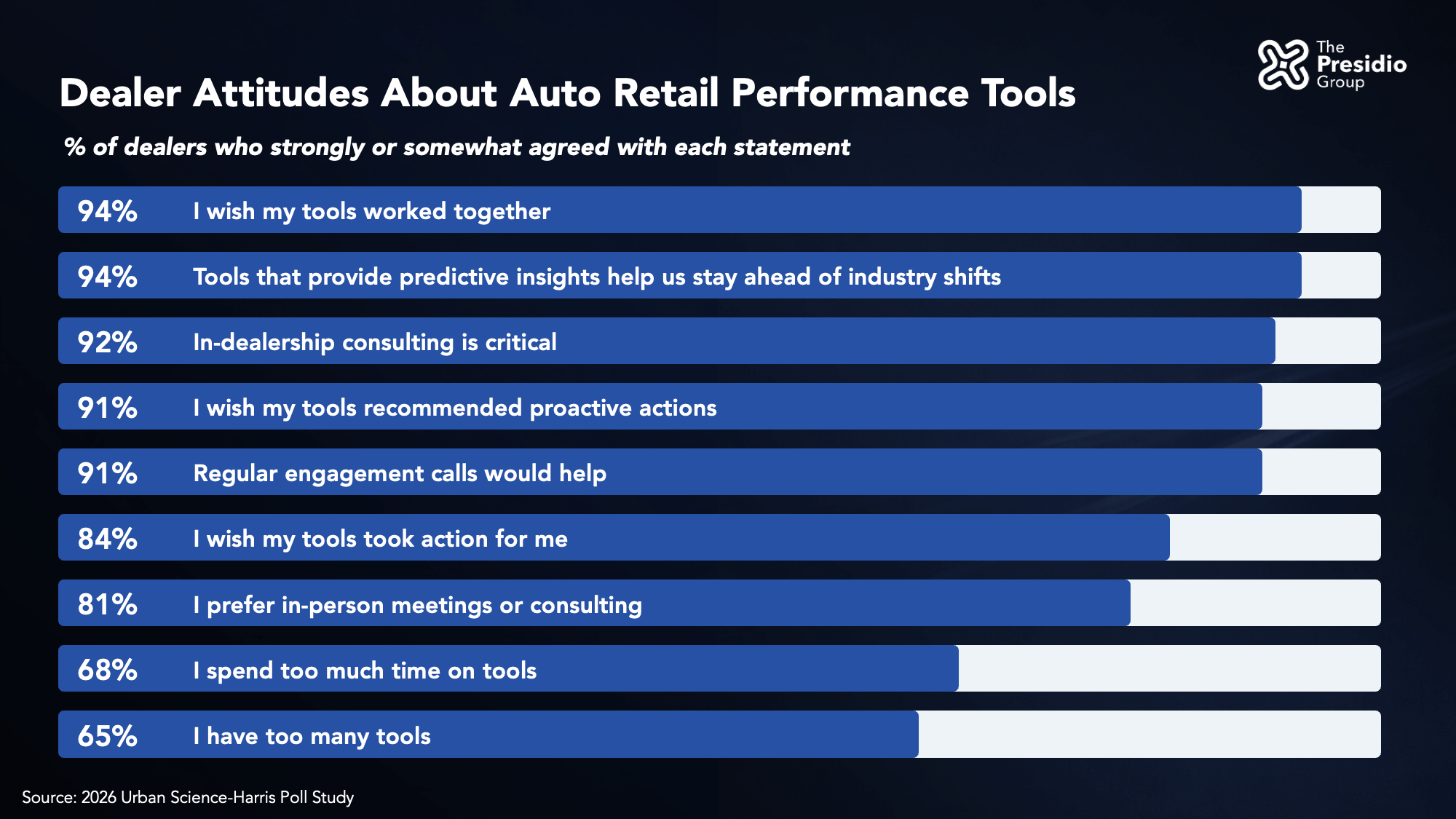
Little wonder that auto retail’s major technology providers are in an arms race to build unified platforms that know and engage customers across every point of their shopping and ownership cycles. Making a dealership group’s tools talk to each other seamlessly throughout that customer journey will be their measure of success.
A truly transformational model would go well beyond today’s generative AI tools, and beyond even the more autonomous agentic systems now gaining popularity. Reynolds and Reynolds calls the next wave cognitive AI and contends it will change the industry like nothing before it.
Beyond agentic AI: Software that remembers
Cognitive AI would allow dealership systems to build memory, applying knowledge accumulated through years of customer interactions and operating decisions, AJ McGowan, Reynolds’ vice president of research and development, said at a company AI summit this summer. A dealership could finally put to work the millions of data points sitting in its systems from every phone call, showroom visit, vehicle sale, repair order and customer exchange — more information than any human could possibly hold, let alone act on.
“That gap between what the [human] knew and what the file holds is the gap that cognitive software closes,” McGowan said. “That’s the shift where AI lives in the data, not adjacent to the data.”
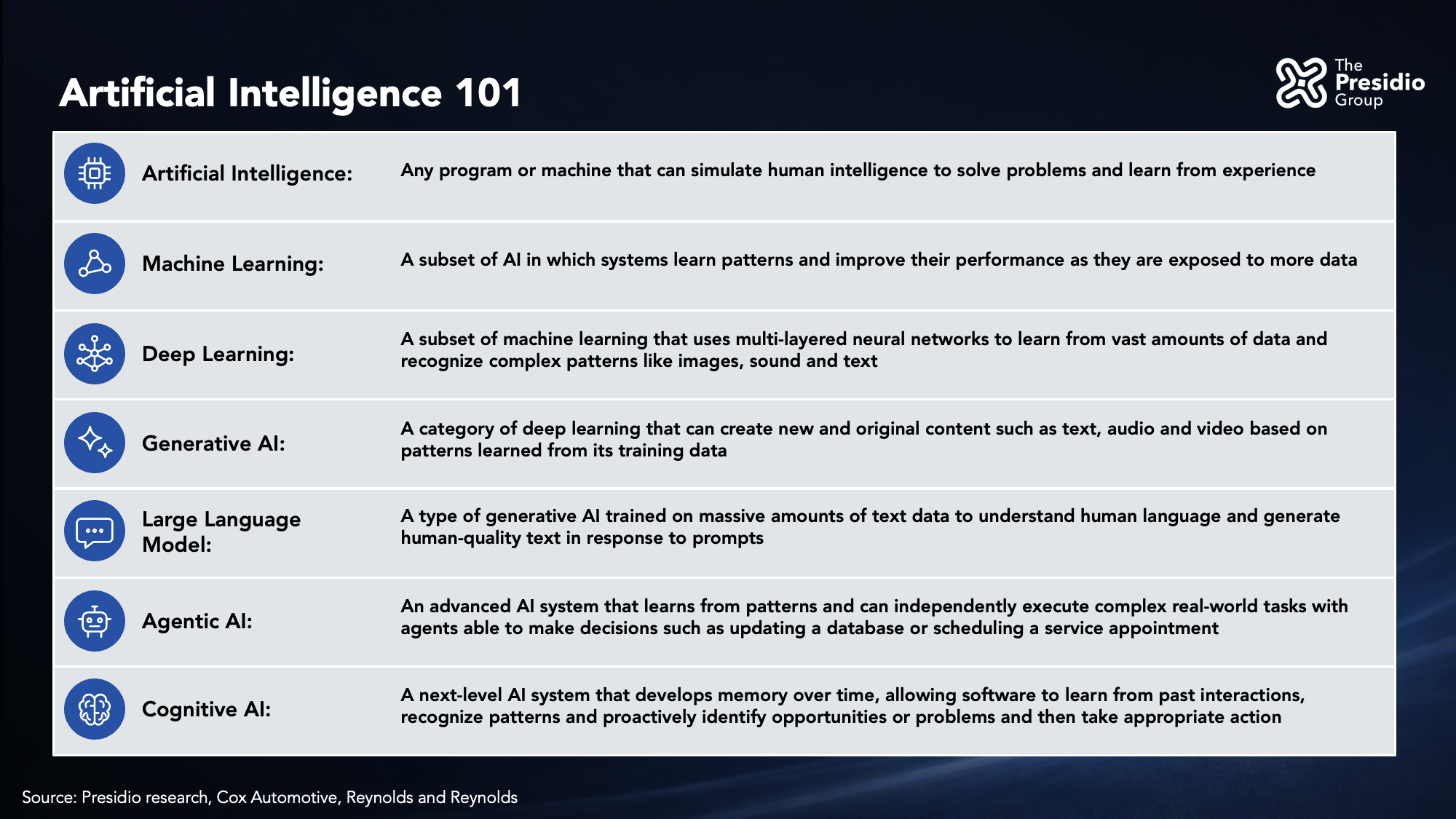
Such software would develop memory across customers, vehicles, employees and dealership operations. It might flag that a customer’s vehicle is aging faster than expected, detect service retention slipping in a particular market or surface a recurring bottleneck before a manager thinks to look for one. Those learnings — and the advantages they create — should compound over time, McGowan said.
For customers, it could mean dealerships that remember what they own, what they’ve shopped for and what service they’ve already had, enabling store outreach tailored to a specific, likely need. For dealerships, it could mean a productivity revolution: the right information in front of both the right employee and the customer at the moment it’s needed.
Auto retail is especially ripe for such change because it combines enormous volumes of repeated work with a heavy personnel burden. A Presidio analysis of regulatory filings for public dealership groups Asbury Automotive Group, AutoNation, Lithia Motors and Sonic Automotive put their average personnel cost through the first half of 2026 at 43.8% of gross profit, excluding technician cost. That figure has barely moved in years — a useful proxy for the economic stakes.
“Forty-plus cents of every dollar in gross profit goes to labor,” Cobb said. “That’s a big opportunity.”
The productivity puzzle
Dealer Eric Flow sees similar untapped potential.
“If we can take a lot of that easy work and direct it toward that technology, that leaves the human more time to solve really complicated things,” Flow said at a Presidio conference in May.
To matter, though, AI has to do more than help an employee finish the same assignment slightly faster. Materially changing the industry’s cost structure means removing steps and consolidating responsibilities — selling and servicing more vehicles without adding employees, and eventually needing fewer of them.
That has proved stubbornly hard to achieve.
“The average salesperson has been selling 10 cars a month since the dawn of the car business, it seems like,” said David Hudson, CEO of Hudson Automotive Group, on Presidio’s Full Throttle podcast. “So what can we do to drive that productivity?”
The question cuts to the heart of AI’s potential value. Strip away the time salespeople spend gathering information, entering data, running routine follow-up and guessing which customers are ready to transact, and that 10-car benchmark could move significantly for the first time in decades. A notably better customer experience would be a bonus.
Alex Perdikis, who owns Koons Motors in Maryland and has developed an agentic AI vehicle sourcing tool called inride, said on the Full Throttle podcast that he is already seeing early signs of that shift. As AI has taken over some of the more mundane parts of their roles, his sales reps and service advisors have grown more efficient, lifting several dealership metrics, including hours per repair order, customer satisfaction, gross profit and per-vehicle revenue.
Magic, with limits
Carvana Co. CEO Ernie Garcia, speaking at the same Presidio conference in May, described the AI capabilities in development in the industry as a catalyst for trying to transform all aspects of Carvana’s business.
“These tools are by far the closest thing to magic that I feel like I’ve ever seen,” Garcia said. “It blows my mind.”
Processes that once took Carvana employees many hours and multiple meetings to sort out can now reach testing after a single meeting, an “amazing” collapse of communications time, he said.
But Garcia added an important caveat: AI tools are only as good as the information they draw on and the clarity of the process the software is directed to complete. A tool may handle predictable questions well but struggle badly without structured rules or dependable data.

Data, in other words, is the foundation of an effective dealership tech stack — and will remain so.
“It’s a matter of taking that data, making it tangible, actionable,” said Tom Kondrat, global lead of advanced analytics at Urban Science. “Better, faster, smarter [and then] putting that in the hands of dealers, that’s where AI is definitely helping.”
Urban Science-Harris Poll research found that 40% of dealership executives say inaccurate or incomplete data has negatively affected performance.
Auto retail’s technology providers are responding by building unified data environments that combine information from dealership management systems, CRMs, websites and other platforms.
“There’s a couple of startups that have popped up that are taking all of this disparate data, DMS data, CRM data, website data,” said Chase Fraser, managing partner at venture capital firm FM Capital. “They’re putting all that data in one place. And then the next move is to run AI off of that data lake and then be able to make good decisions.”
Lithia’s early test
Among public dealership groups, Lithia Motors may be the clearest test of what AI-enabled operating leverage will look like at scale.
CEO Bryan DeBoer has called for a 20% to 50% reduction in technology cost as the group overhauls its tech stack and converts to Pinewood.AI — in search of a single operating platform combining dealership management, workflow automation and embedded AI while reducing reliance on a patchwork of third-party vendors.
Pinewood’s AI capabilities should help drive Lithia’s adjusted selling, general and administrative costs to less than 60% of gross profit over time, DeBoer said on the company’s second-quarter earnings call in July. That metric was 69% in 2025.
“We don’t see it as disruptive,” he said. “We see it as constructive.”
Early results in the company’s United Kingdom operations support that conviction. Lithia reported a 200-basis-point improvement in SG&A year over year in that market, with management attributing roughly half the gain to Pinewood.
When AI grows hands
The AI discussion increasingly extends beyond software, chatbots, agents and data.
Over time, advances in automation and robotics could push it into physical dealership operations as well. FM Capital has invested in a robotic tire-changing company, and dealership groups such as Holman are experimenting with robotics, including machines that move parts around service departments.

Robots could ultimately be “a bigger labor decreaser than even AI,” Fraser said.
How fully AI delivers on its promise over the next five years will depend on the industry’s ability to build massive and clean datasets, integrated platforms and redesigned workflows.
For a growing number of dealership executives, investors and technology providers, though, the end state is getting easier to picture: a dealership that spends far less time shuffling information around and far more time acting on it.
“The change that’s coming … we’ve not seen anything that even scratches this,” Fraser said. “This is seismic. Seismic.”
This material has been prepared solely for informational and educational purposes and should not be construed as tax, legal, accounting, or investment advice, nor as a recommendation to engage in any specific transaction or investment strategy. Recipients should consult their own professional advisors regarding their individual circumstances. Any views or opinions expressed are subject to change without notice. Past performance does not guarantee and should not be relied upon as an indicator of, future results.