
One dealer responding to a recent survey by The Presidio Group had a blunt way of describing the technology boom now consuming auto retail: “A bona fide arms race.”
That characterization captures something the underlying numbers only hint at. Artificial intelligence has moved, in the span of a few years, from a novelty pitched by scrappy startups to a fixture of daily dealership operations — answering phones, chasing leads, pricing trade-ins, auditing invoices and helping employees make sense of data that used to sit largely unexamined in dealership management systems. The tools are expanding so fast that dealers now can spend nearly as much time sorting through products and vendors as they do deploying the software itself.
“The opportunity for AI in automotive retail is staggering,” said Brodie Cobb, CEO of The Presidio Group. “This first wave of real-world applications is changing how dealers communicate with customers, manage their operations and think about productivity as they strive to streamline what’s routine and repeatable. AI is often better, faster and more consistent than purely manual processes.”
While data about adoption rates varies, several recent industry surveys demonstrate that dealerships are increasingly using AI tools and finding value in them. While adoption is early yet and resulting improvements minor as of today, the Presidio view is that AI, within the span of the next five years, will prove to be the most productive operating technology experienced in auto retailing in more than 100 years.
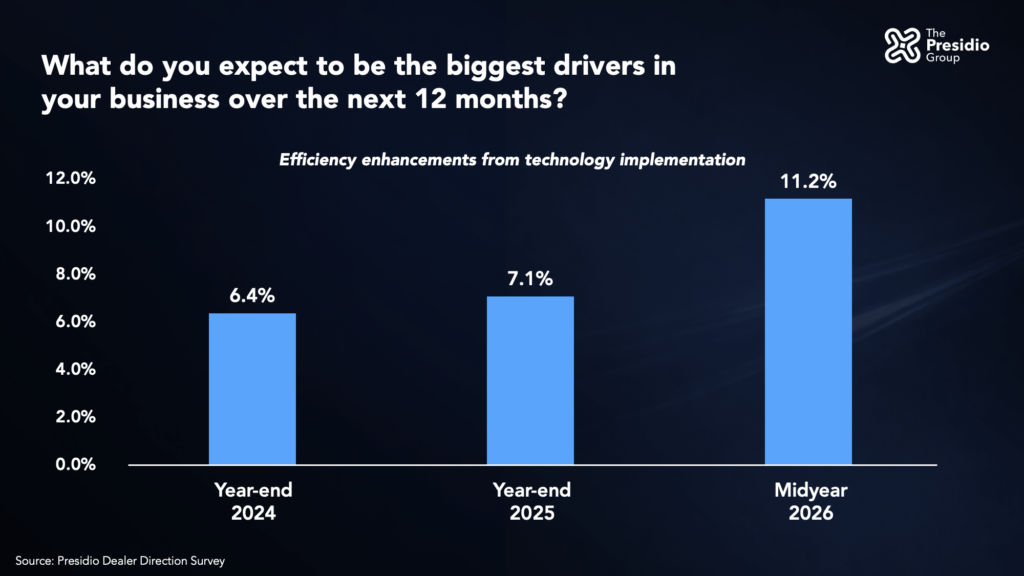
Many dealers already are placing strong expectations on AI. In the Presidio Midyear 2026 Dealer Direction Survey, 11.2% of respondents said efficiency enhancements from technology implementation would be a top driver of business results over the next year. That’s nearly double 6.4% who said that at year-end 2024, the first time that question was asked in Presidio’s twice-a-year survey.
And adoption is speeding up. Cox Automotive’s AI in Auto Retail Tracker put dealership AI usage at 82% in the secondquarter of 2026. A Reynolds and Reynolds survey conducted in late 2025 found 57% of dealership personnel using AI, climbing to 70% among top executives and dealer principals. Presidio’s year-end 2025 survey found more than 93% of respondents had expanded, or planned within the next 12 months to expand, their use of software tools, including AI-enabled products.
The surveys aren’t directly comparable — different respondents, different timing, different questions. But combined, they tell a consistent story: AI use has spread well beyond a small group of experimental dealers. Among large and sophisticated dealership groups, the technology likely will soon be commonplace — and those retailers will be positioned to capture potentially transformative operating gains when AI becomes embedded end-to-end across dealership tech stacks.

Use cases are as varied as the vendors selling them.
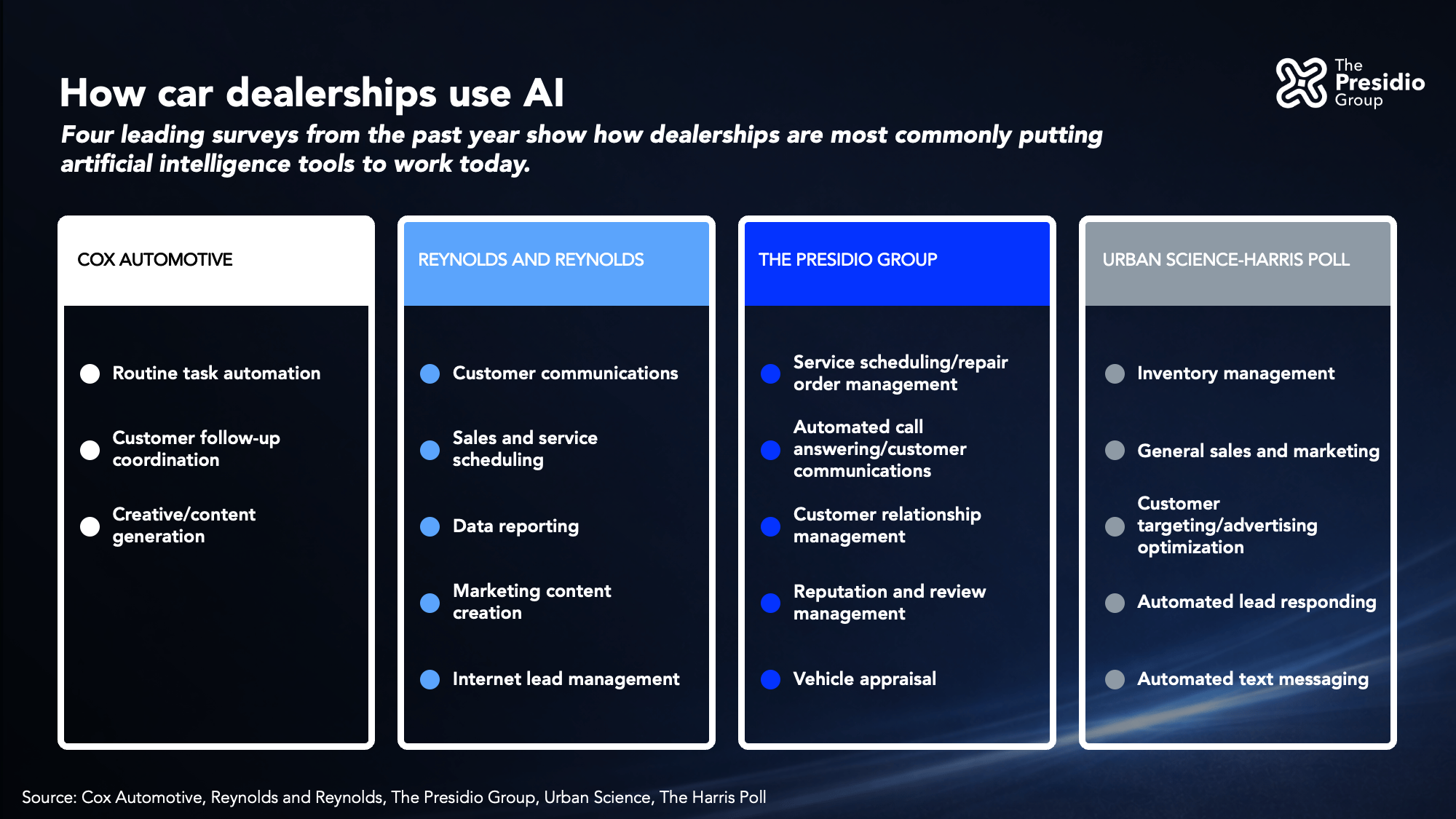
Cox’s survey found dealers mostly using AI to automate routine or complex tasks and coordinate customer follow-up, with content generation close behind. Reynolds’ respondents pointed to customer communications, scheduling, reporting, marketing content and internet leads. An Urban Science-Harris Poll survey released earlier this year found dealers focusing heavily on inventory management, general sales and marketing, customer outreach and advertising, with automated lead response and automated messaging not far behind.
In Presidio’s survey, 68% of respondents reported positive experiences overall, with service scheduling, automated call answering, customer service management, reputation management and vehicle appraisals topping the list of most-used tools.
Public groups aren’t waiting
The country’s six publicly traded dealership groups aren’t sitting on the sidelines. AI is a central piece of the dealership management system and tech stack overhauls now underway at Lithia Motors and Asbury Automotive Group. Group 1 Automotive has more than 50 AI-enabled projects in motion, J.P. Morgan noted in a recent research report.
“Many of these investments are still in the early stages, but they are beginning to demonstrate real benefits,” Group 1 CEO Daryl Kenningham said in July. “AI can support customer acquisition and retention, enhance inventory optimization through more informed sourcing decisions, drive efficiencies by digitizing processes to reduce SG&A, and put more consistency and performance across all of our rooftops, a key strategic focus for Group 1. We will continue to drive these efforts.”
The uptake has moved AI beyond a “forward-looking bet for dealers,” Inga Maurer, a partner at consulting firm McKinsey & Co., recently told Automotive News.
“It is becoming a core defense play,” she said. “The groups investing now are trying to protect margin, improve customer experience and build operating advantages that compound over time.”
Where rubber meets the road
That is certainly the case at Hudson Automotive Group, where CEO David Hudson has put AI to work scheduling service and maintenance appointments — freeing his business development center employees for higher-value work, such as outreach to customers nearing the end of a lease.“
We haven’t really seen a workforce reduction or reduction in expense, but we’ve seen a significant boost in productivity,” Hudson said recently on Presidio’s Full Throttle podcast.
Hudson’s group has also turned AI loose on its own paperwork: an accounting application checks a roughly 3,500-line monthly DMS invoice against the group’s contract and pricing addendums. That regular review has already identified charges inconsistent with negotiated terms, producing real savings and prompting Hudson to extend the process to other vendors.
Integration is the new battleground
Some of the industry’s more advanced applications go further, pairing automation with information pulled directly from dealership systems. Increasingly, how well a tool plugs into the rest of a dealership’s tech stack matters as much as what it can do on its own.
Matt Leone, CEO of customer relationship management platform provider DriveCentric, has watched plenty of early AI products stumble for exactly that reason: they arrived as disconnected bolt-ons, forced dealers to manage separate agents across multiple systems or came from newer providers without adequate security and compliance controls. He expects adoption to accelerate as more AI gets embedded directly into established dealership platforms, managed with a single, consistent voice and process rather than a patchwork of them.
“We want to build a platform which you could build your extensions on,” Leone said on Presidio’s Full Throttle podcast. “Perhaps you have some miscellaneous tasks within your dealership. Perhaps there’s some consolidation of data that you want to be able to aggregate up. That’s where AI can be just immensely helpful for you.”
Devin Daly, CEO of AI operating system provider Impel, frames AI’s appeal even more simply — as “a triple-threat value proposition.”
“Traditional software really only had one value prop — it would either cut costs, improve conversion or improve the customer experience,” Daly said at a Presidio conference in May. “And AI is really unique in that it can do all three of those things.”
Daly pointed to one very large dealership group that piloted Impel’s product in a small region before expanding it to all locations and franchises, producing a demonstrable lift in vehicle sales.

Cheap to launch, hard to survive
New products aren’t just proliferating — they’re proliferating cheaply, which is part of why the “arms race” description resonates.
Chase Fraser, managing partner at venture capital firm FM Capital, has watched the investment required to launch a technology company fall from roughly $5 million to less than $100,000 in the span of just a few years. His team regularly runs into new vendors cropping up. Many of those could eventually fail or be absorbed into more established tech providers, he said.
Consolidation already has begun. Cox Automotive’s June acquisition of Fullpath folds Fullpath’s customer data platform and agentic AI capabilities into shopping activity from Autotrader and Kelley Blue Book, alongside dealership CRM, DMS, service and purchase records — an early sign of the market consolidating around data and scale.
For dealers, that combination of rapid development and looming consolidation cuts both ways. It means more products worth testing, but also more risk of betting on a tool — or a whole platform — that could be orphaned before it pays off.
Hudson has settled on a rule of thumb: stay “on the cutting edge of technology but not the bleeding edge.”
Over the past two years, promising vendors have repeatedly been caught or surpassed by faster-moving competitors, and hardly a week goes by without another pitch landing on his desk. The real work, he said, is filtering those pitches for the ones that fit his group’s culture and operating model and can meaningfully cut costs or lift productivity.
“It’s coming at us fast and furious and a lot of stuff to sift through to make sure that we’re spending our technology dollars wisely,” Hudson said.
The expectations gap
For all the momentum, the industry’s own data suggests expectations are still running ahead of results.
This is only natural with the transformational tsunami that AI is poised to unleash across auto retail. With billions of repetitive transactions and processes occurring across 18,000-plus dealerships annually and an average personnel cost representing approximately 45% of gross profit, the U.S. auto retail sector is a prime target for AI’s help.
Cox Automotive found 69% of dealers expected AI to drive sales and revenue growth, but only 22% of AI-using dealers had experienced that benefit. Fifty-four percent expected employee productivity gains, compared with 26% who had experienced them. Fifty-one percent expected improved profit, while just 9% reported seeing it. Roughly a third of dealers weren’t formally measuring AI’s impact at all or weren’t sure how it was being measured.
That gap isn’t evidence AI is failing — it’s a reminder of how early this still is. Look down the road five years, and much will have changed. By what order of magnitude is still the question.