

When Toyota Motors North America President and COO Jack Hollis took the stage at Presidio’s 2023 U.S. Auto Retail Conference, market and media sentiment around the pace of battery electric vehicle adoption was still optimistic and the Japan-based automaker was considered out of touch with the future of the U.S. auto industry. While drivetrain options and their impact on an automakers’ profit and loss are under constant consideration, Toyota leaders have remained steadfast in trusting their analysis that implementing various technologies is the correct strategy if carbon footprint reduction is the true goal.
At that Presidio conference, Jack discussed Toyota’s 1:6:90 rule, which asserts that the materials needed to create one battery electric vehicle can be distributed more efficiently, strategically and economically to build six plug-in hybrids or 90 gasoline hybrids. Dealers represent customers that want drivetrain diversity and choice. Technological singularity – regardless of drivetrain type, including internal combustion – ultimately faces multiple problems in an addressable market that is extremely diverse.
Discussing the current environment with Kevin Tynan, Presidio’s new director of research, I asked for his take on why Toyota’s long-game strategy is so effective after being lamented as dangerously pragmatic as recently as 2023. Our goal at Presidio is to provide expertise and insight to clients through our core M&A and banking services. Our market research and analysis team will join the pursuit by tracking the pulse of the U.S. auto retail market while our Dealership Advisory Services and AutoTech Services teams focus on running their businesses and achieving successful outcomes for our clients. If you’d like to discuss this or any topics with the team, reach out to Kevin Tynan directly at ktynan@thepresidiogroup.com.
Sincerely,
Brodie Cobb
CEO
The Presidio Group
Toyota Quietly Is The Gasoline Hybrid Leader Amid BEV Noise
Having pioneered the gasoline hybrid segment in North America with the Prius in 2000, Toyota’s grasp of the new-vehicle profit profile in the U.S. has enabled the automaker to avoid parlaying its early-mover fuel efficiency advantage into money-losing technologies.
Below-average price points can spur volume in a soft demand and high interest rate environment. Toyota sells seven hybrid nameplates, with the average price of five of them — the Camry, Corolla, Corolla Cross, Prius and RAV4 hybrids — below the industry’s average new-vehicle price of $46,700 in the second quarter. (The average price for Highlander and Grand Highlander hybrids came in above $50,000.) While below-industry prices for most of Toyota’s hybrids boost demand, maintaining rational inventory for those nameplates helps preserve profitability — and retail gross profits for franchised dealerships on those Toyota hybrid nameplates range from 1.7x to 4.7x the broader industry average.
By contrast, Hyundai-Kia sells six nameplates with a gasoline hybrid trim level, and those models generate less than $1,000 in per-vehicle retail gross profit for the dealer base.

More Hybrids Needed as Overstocked BEVs and PHEVs Distract Automakers
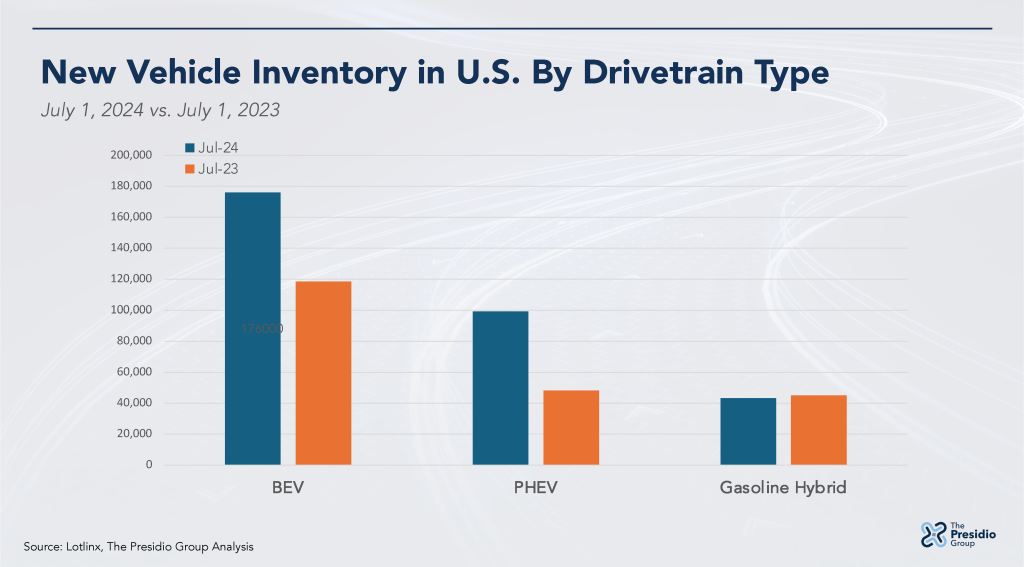
Gasoline hybrid is the drivetrain tech that may be able to add inventory without damaging transaction price and margin. There were 43,000 hybrid units on the ground at U.S. dealerships on July 1, a 4% decline year over year. Given the pace of sales and Toyota dealers can expect a flow of Camry, Corolla, Highlander and RAV4 gasoline hybrids. As the longest-tenured gasoline hybrid seller in the U.S., Toyota’s profit dynamics are superior to competitors that will be new to the segment or re-entering it at scale.
The additional ramp in supply coming for BEV and plug-in hybrid electric vehicles will mean more discounts and incentives to move that metal. July, after all, began with 176,000 BEV units on the ground – not including direct sellers Tesla, Lucid, Rivian and Polestar – a 48% increase year over year and equivalent to a 147-day supply of those vehicles for the legacy automakers. PHEV inventory grew by 105% to 99,000 units to start the third quarter.
Gas Hybrid Has Better Profit Dynamics at Lower Price
As the deficient profit profile of BEVs couples with a price premium that mutes demand for financially tentative consumers, automakers are stepping back on BEV and PHEV tech to refocus on gasoline hybrid nameplates and even traditional internal combustion engine vehicles.
Seeking a balance between volume and profitability, many manufacturers are feeling the pressure of overspending on BEV with unfavorable return on investment in an unproven demand environment. Automakers’ strategies and pace of progress on BEVs varied based on many issues and reasons, almost all of them profit-driven.
Gasoline hybrids generated a median retail gross profit of $1,142 for dealers in June, 5.8x better than PHEVs. Median gross profit per unit for BEVs was $621, or 1% of their transaction price in the second quarter, compared with 4.2% for gasoline hybrids in the period.
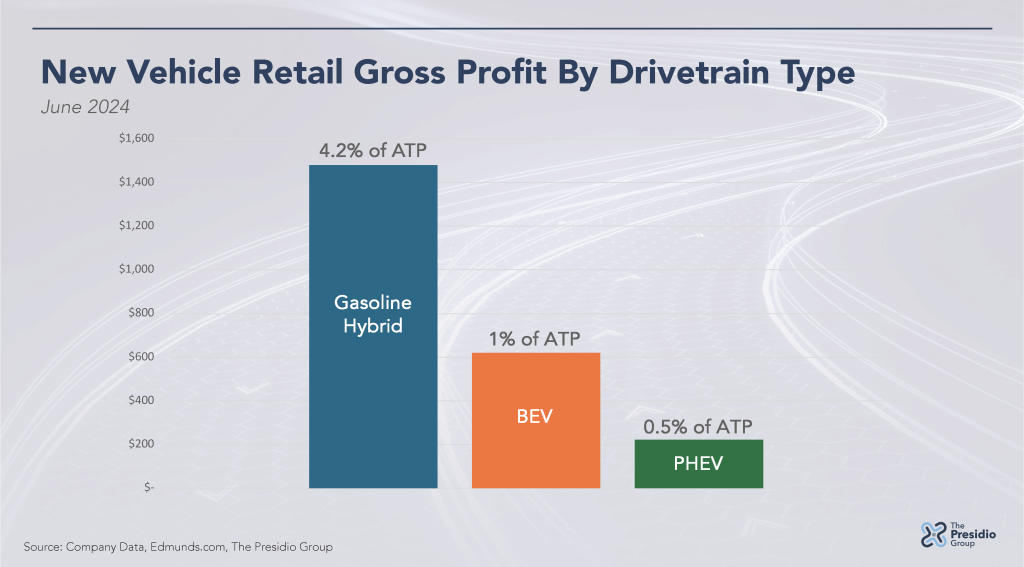
This margin dynamic is unconventional, as the median transaction price of the older and less advanced gasoline hybrid tech was $35,180, a 29% discount to PHEVs and 42% less than the sales-weighted BEV transaction price – a case for higher unit sales, though usually not for greater per-unit profitability.

Automakers’ Primary Goal Is Profit, and BEVs Are Failing Legacy and Pure-Play Automakers
With the myriad of reasons behind the deceleration of consumer adoption of BEVs in 2024 – range anxiety, quality issues, lacking charging infrastructure, price premiums that will take years to pay back – none are as impactful as manufacturers failing to see the financial motivation to quickly create production and distribution scale for a money-losing drivetrain type.
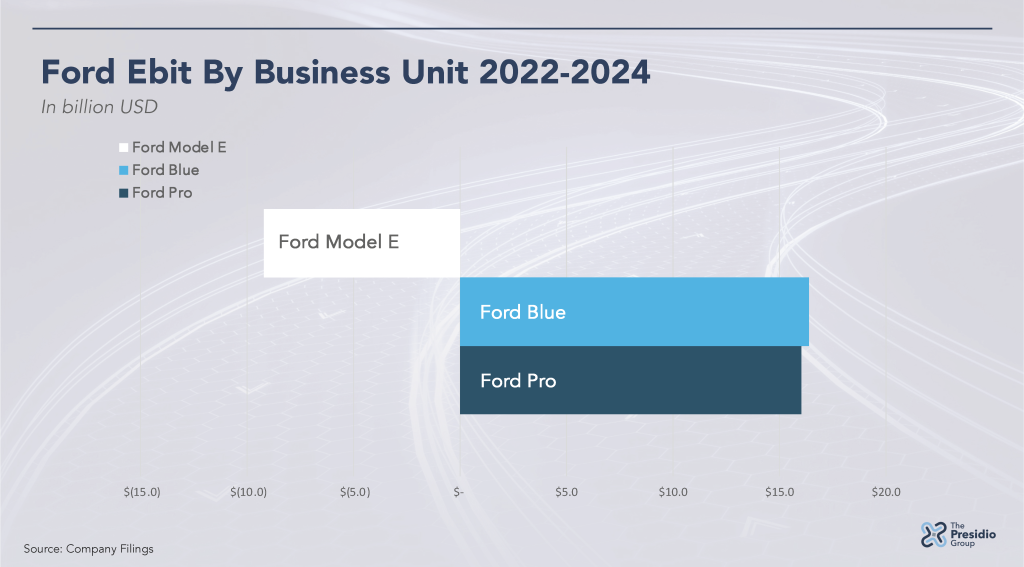
Ford rushed to get its electric SUV and full-size pickup – Mustang Mach E and Ford F-150 Lightning – to market to protect market share of its two most important revenue and profit contributors, the Explorer and F-Series nameplates, which represented $14.6 billion or 53% of the company’s total U.S. new vehicle retail revenue in the second quarter. The company sold 248,000 BEVs from 2022 through June 2024, booking an earnings before interest and taxes (Ebit) loss of $9.3 billion or $37,500 per vehicle.
Ford Motor Co. is forecasting as much as a $5.5 billion Ebit loss from its Model E business unit in 2024, intensifying from a $4.7 billion Ebit loss for that unit in 2023, as the per-unit economics are worsening. In the first half of 2024, the Ebit shortfall was $68,000 per vehicle, up from $40,500 in full-year 2023 and $22,200 in 2022.
Pure-Play BEV Builders Can’t Cover Cost of Goods Without Distribution Scale
Franchised dealers can expect the financially devastating profit dynamics to motivate legacy automakers to back off BEV production more quickly than the nascent pure-BEV manufacturers such as Lucid and Rivian – companies that have no other drivetrain alternatives. Rivian and Lucid have not covered their bill of goods – revenue greater than cost of goods sold – since starting BEV production.
As BEV demand started to flag in 2023, the lack of franchised distribution partners for those upstart manufacturers forced them to slow their production ramps as the companies were paying to build vehicles they could not deliver and were forced to carry on their own balance sheets. Lucid has booked $2.5 billion in gross profit losses since the third quarter of 2021 and Rivian has accumulated a $5.6 billion shortfall in the same timeframe.

Competing – and long profitable – drivetrain technologies are making BEV investments by legacy and pure-play EV automakers look ill-conceived. Ford, Rivian and Lucid BEV sales have generated $37 billion in pretax losses since 2022, with a flagging likelihood that the profit dynamics and demand profile will improve dramatically – and soon – and enough to get cost-saving production scale across the industry.
Automaker motivations on drivetrain strategy are as varied as the companies themselves, as government subsidies in China, profit- and image-crushing penalties in Europe, or the pursuit of a market capitalization multiple like the pure-play EV-only companies in the U.S. force manufacturers to abruptly choose a path.
Resisting the lure or pressure of those external considerations, Toyota’s gasoline hybrid commitment has generated 2.5 million Prius sales in the U.S. since 2000 and has expanded into Camry, Corolla, Highlander and RAV4. The company’s inclusive drivetrain strategy means it can continue to sell gasoline hybrids while controlling the pace of its plug-in hybrid and battery electric vehicle ramps to effectively deploy capital and preserve profitability.