
Publics’ Q3 earnings decline narrows, but new-vehicle and F&I profits slide
The six U.S. public dealership groups in the third quarter collectively sold fewer new vehicles than a year earlier, earned less on each one and spent a larger share of gross profit operating their stores. They faced a tough comparison against last year’s third quarter, when consumers rushed to buy electric vehicles before federal tax credits expired Sept. 30, 2025. The comparison weighed on new-vehicle sales, but executives pointed to parts and service and early technology gains as opportunities.
The six publics — Asbury Automotive Group Inc., AutoNation Inc., Group 1 Automotive Inc., Lithia Motors Inc., Penske Automotive Group Inc. and Sonic Automotive Inc. — generated a total of $885.2 million in adjusted net income in the third quarter, down 8.7% from $969.6 million a year earlier. The decline narrowed from 11% in the second quarter and 16.2% in the first. The earnings fall-off was near universal with Penske reporting the only year-over-year gain, with its adjusted net income up 3.7%. The other five publics posted declines ranging from 5% for Lithia on the low end to 21% for Asbury on the high end.
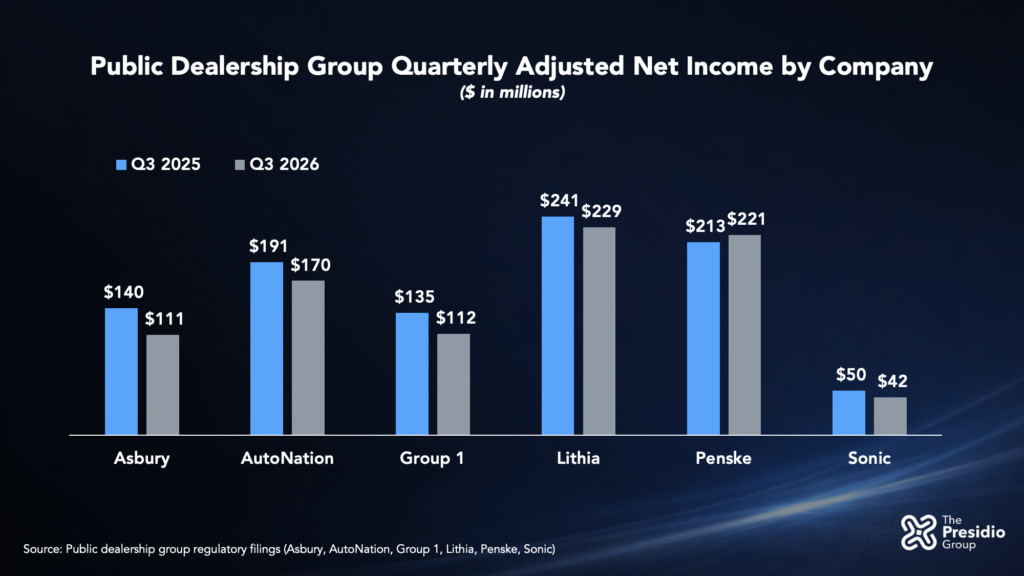
The public dealership group results reflect the broader market tracked by the Presidio-NCM Average Dealership Performance Benchmark, which includes more than 4,000 U.S. franchised dealerships. The Presidio-NCM benchmark showed net pretax profit falling 9.9% year over year in the third quarter, after declines of 11.2% and 11.8% in 2026’s first two quarters.
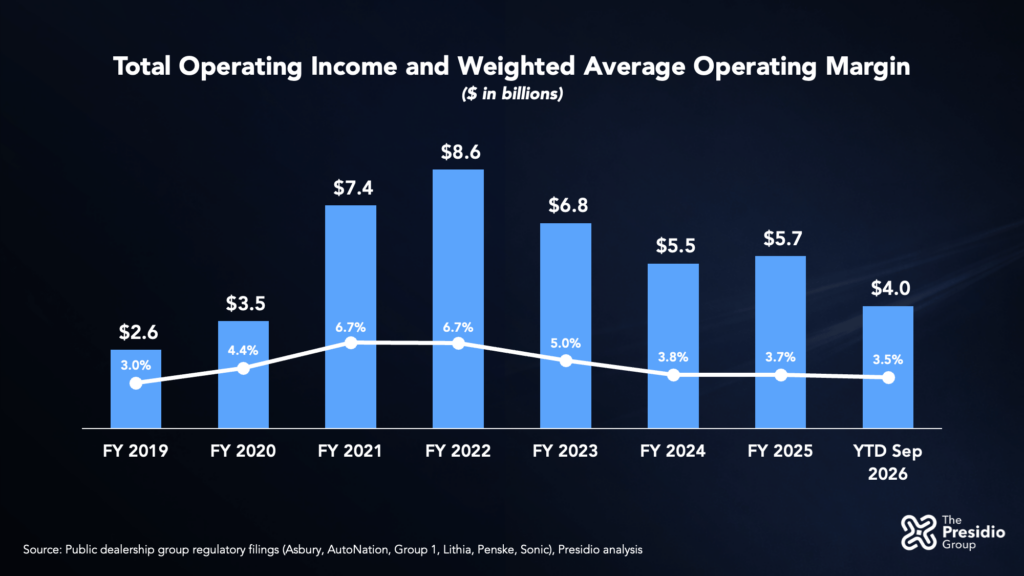
The publics collectively posted a weighted average operating margin of 3.5% for the first nine months of 2026, down from 3.9% for the first nine months of 2025 and slightly below full-year 2025’s 3.7%. Operating margin performance was choppy during 2025 as the effects of tariff increases and the end of the EV tax credits altered typical seasonal buying patterns. The peer group’s 2026 margin continues to track well above 2019’s pre-pandemic level of 3.0%.
New-vehicle profitability slips from both Q2 and the year-earlier quarter
Using Presidio’s weighted U.S.-adjusted public composite, which excludes non-franchised dealerships and non-U.S. operations where possible, same-store revenue for the publics fell 2.0% year over year in the third quarter, and gross profit fell 3.4%. New-vehicle unit sales dropped 4.4%, while used-vehicle unit sales declined 3.3%.
Profitability trends for new and used diverged.
New-vehicle unit profitability started to slide again in the third quarter after several quarters of relative stabilization. The publics’ average gross profit per new vehicle retailed dropped 5.4% year over year to $3,038 in the third quarter and fell 3.9% from the second quarter, according to the Presidio composite. The combination of lower margin and volume pushed total new-vehicle gross profit down 9.6%. All six groups saw adjusted same-store new-vehicle gross profit fall, ranging from a 4.6% dip for Penske to a 19.7% decline for Asbury. Sonic was the lone public to post slightly higher new-vehicle gross profit per unit compared with the year-earlier quarter.
Sonic President Jeff Dyke said the company held a reset call with sales managers after the second quarter. “We are just not going to give cars away,” Dyke said. “We were able to contain market share and … grow our margin a little bit.”
On the used side, per-unit gross profit rose 4.5% year over year to $1,764, though it fell from the second quarter, according to the Presidio composite. Total used-vehicle gross profit rose 1.0% year over year, even with lower volume. Results varied by company. Group 1, AutoNation, Asbury and Lithia raised per-unit profit but sold fewer used vehicles, while Penske and Sonic sold more at lower per-unit profit. Only Asbury and Lithia’s margin gains were large enough to lift total used gross profit.
Lithia CEO Bryan DeBoer touted a 44% leap in per-unit gross profit in its core three- to eight-year-old vehicle category.
“In used vehicles, our pricing strategy continues to deliver, and it’s a great example of our ecosystem, technology, and people all working together as one,” DeBoer said on Lithia’s earnings call.
Fixed operations is a boost, but growth continues to be slow
Fixed operations remains the publics’ biggest earnings pillar, but it’s not without challenge. Gross profit growth in the department continues to be slow, up just 1.1% year over year in the third quarter and narrower than in both the first and second quarters, according to the Presidio composite. By contrast, third-quarter fixed-operations gross profit rose 5.0% for dealerships contributing to the Presidio-NCM benchmark.
Fixed ops contributed 47.3% of all same-store gross profit for the peer group, up from 45.2% a year earlier, as new-vehicle and F&I gross profit shrank. Performance varied across the six companies, with adjusted same-store fixed-ops gross profit declining 2.3% at Asbury and 0.8% at Group 1 and increasing 0.8% at AutoNation, 1.2% at Sonic, 2.4% at Lithia and 3.3% at Penske. Public company leaders emphasized the opportunity in parts and service and described efforts to boost the business.
For Asbury, the completion of its conversion to the Tekion dealership management system was cited as a factor in fixed-ops margin compression as service department employees learned the new technology. Looking ahead, the Tekion tools are expected to help improve fixed-ops results. Asbury CEO Dan Clara pointed out that the group of stores on the Tekion platform for the longest saw fixed gross profit grow 5% against the total company’s same-store decline. And customer-pay gross profit grew 7% at the early adopter stores vs. being flat for the total company.
“It takes time for team members to build the muscle memory that comes with a new platform before taking it to another level,” Clara said.
At Group 1, CEO Daryl Kenningham attributed the challenge in part to the industry’s low-volume sales years of 2020 through 2022. Vehicles sold during that pandemic period are now prime candidates for repairs, but there are fewer of them on the road as consumers face rising costs.
“To recapture and keep those customers in Group 1 dealerships, we focused first on affordability,” Kenningham said.
Parts-and-service pricing and affordability was named as an area for improvement by most of the publics. “There’s no question we got too expensive in our service drive,” said Sonic CEO David Smith, adding that value pricing is being rolled out to the company’s dealerships.
Dealers remain broadly optimistic about parts and service, with 80% of respondents to the Presidio Midyear 2026 Dealer Direction Survey saying they expected the department to be one of their top profit drivers this year and into 2027.
Finance-and-insurance gross profit declined 7.0% in the third quarter, per the Presidio adjusted composite, as per-vehicle F&I income dipped 3.3% and vehicle unit sales declined. Per-vehicle F&I income fell at five of the six groups, with Lithia and Penske each down more than 4%. Sonic was the exception, posting a 2.5% increase.
Operating leverage slips, but costs still separate operators
Costs took a larger share of gross profit for the publics in the third quarter as lower new-vehicle and F&I profit pulled down total gross profit. On a weighted composite basis, adjusted selling, general and administrative expenses accounted for 70.9% of total gross profit, worse than the 69.1% recorded in 2025’s third quarter.
Asbury, AutoNation and Lithia kept SG&A below 70% of gross profit. Asbury had the lowest ratio at 67.4% as Clara credited the Tekion migration and said leverage is expected to improve further in the fourth quarter.
“With the Tekion conversion now complete, we believe our SG&A can reach the low 60% range by the end of 2027, driven by efficiency gains as our teams become more productive on the platform,” Clara said.
Lithia held its ratio nearly flat sequentially, coming in at 68.8% for the third quarter. DeBoer credited combined sales roles, fewer management layers, automation and AI tools, and the company said its North American same-store ratio improved 50 basis points sequentially, to 65.7%.
While Lithia is targeting SG&A leverage below 60%, achieving that will require completing its rollout of Pinewood.AI’s technology platform. Lithia is expanding Pinewood from its United Kingdom stores to its North American dealerships, with the conversion scheduled to finish by the end of 2028.
Sonic was an outlier as its ratio jumped to 75.4%. Higher SG&A as a percentage of gross profit “pressured our bottom-line,” though Sonic remains within its full-year guidance range, Smith said.
Public group executives said artificial intelligence gains are beginning to show up, particularly in service, pricing and back-office work. Technology costs, however, can be higher as new tools are launched.
DeBoer said an AI tool that books service appointments in Lithia’s U.K. stores is generating around 10% of additional pre-sales by asking customers about potential additional work. Sonic credited back-office automation and AI for saving $2.6 million so far this year and said AI pricing tools for fixed operations and inventory are rolling out in the fourth quarter. At the same time, $2 million of incremental spending tied to Sonic’s AI initiative also landed in the third quarter.
M&A pace slows in Q3 as liquidity builds ahead of Q4 activity pickup
The publics collectively spent $1.65 billion on acquisitions during the first nine months of 2026 and generated $1.12 billion in divestiture proceeds. But just 10% of the acquisition spending and 14% of the divestiture proceeds occurred in the third quarter as the pace of transactions slowed with two dealerships bought and four sold across the peer group.
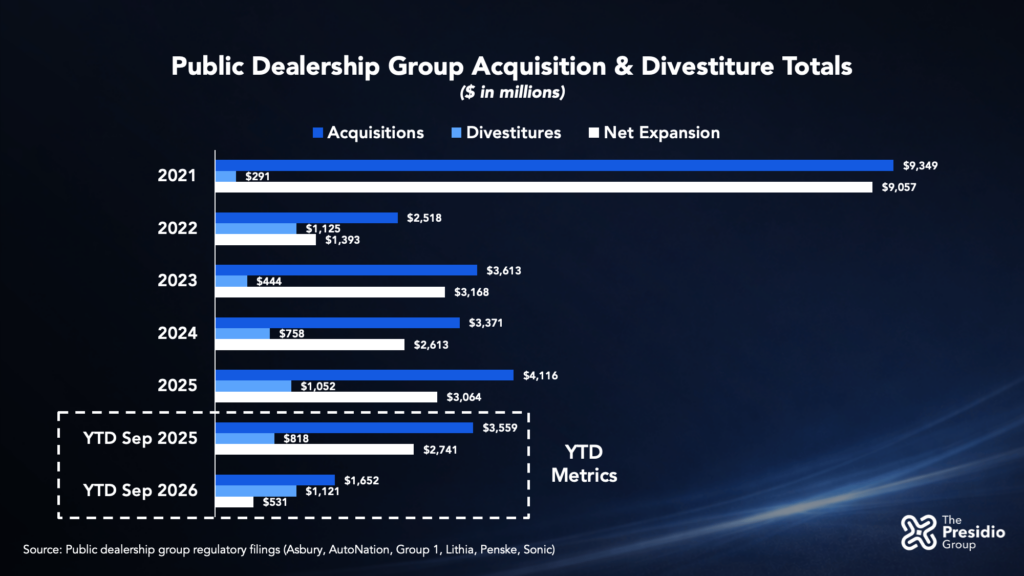
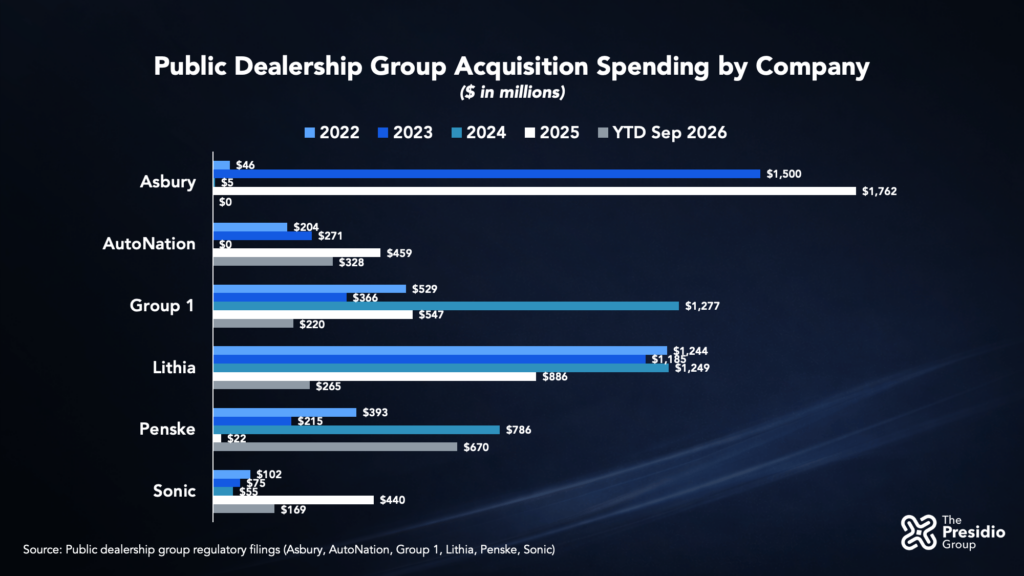
Activity, however, has already heated up in the fourth quarter. Lithia bought four stores in Memphis in October. Group 1 closed its $1.3 billion acquisition of Hennessy Automobile Companies in Atlanta and completed sales of Lexus, Acura and Honda dealerships for about $235 million in proceeds in October. The Presidio Group advised Group 1 on the divestitures of those three stores last month. Group 1 also disclosed it had agreements in place to divest another four stores for expected proceeds of about $125 million.
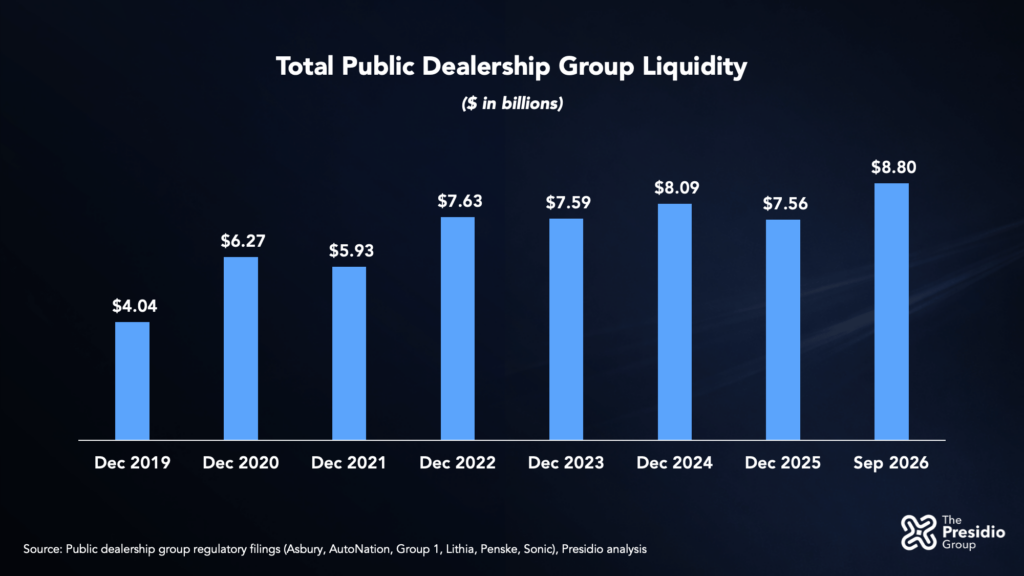
The peer group’s total liquidity rose 34% from $6.59 billion on June 30 to $8.80 billion on Sept. 30, but that lift was temporary. Group 1 contributed by closing a $1.25 billion offering of senior notes on Sept. 22 to help finance the Hennessy acquisition completed Oct. 19. Excluding Group 1, the publics’ combined liquidity rose 7% from June 30 but fell 5.3% since the end of 2025.
Public company leaders stressed balance in capital allocation, weighing acquisitions and share buybacks against the need to keep debt in check.
Group 1 said its rent-adjusted debt-to-earnings ratio stood at 3.3x at the end of September and would have been about 4x counting Hennessy and the store sales disclosed in October. Reducing leverage is the company’s immediate priority, and it aims to trim that ratio to 3x by mid-to-late 2027. It could resume buybacks as it nears that target. Asbury said its leverage ratio was 3.5x at the end of the third quarter and that it intends to reduce that to 3x by mid-2027.
AutoNation repurchased $162.9 million of stock in the third quarter and plans to continue buybacks “as a preferred use of incremental capital,” CEO Mike Manley said. “In current market conditions, our share price is attractive.” Lithia bought back $85 million in stock in the quarter.
Valuations fall for most groups as Penske heads private
Penske agreed in October to a buyout offer from its major shareholders, Penske Corp. and Mitsui, that is expected to take the retailer private in early 2027. Penske did not host a third-quarter earnings call.
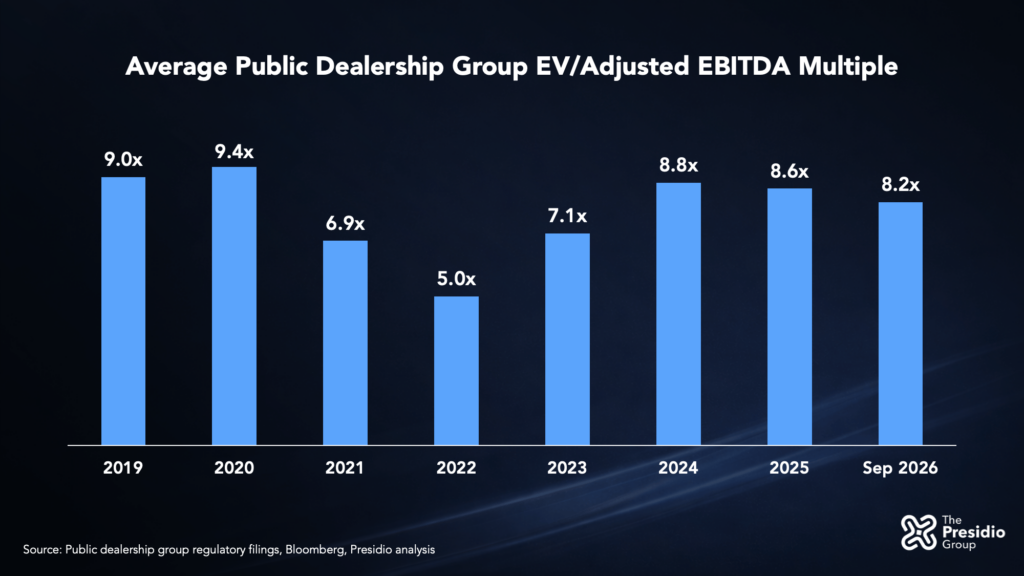
Presidio typically calculates the publics’ enterprise value-to-adjusted EBITDA multiples at quarter’s end. The peer group’s blended multiple as of Sept. 30 was 8.2x, down from 8.4x on June 30 and 8.6x at year-end 2025. Excluding Penske, that multiple was 7.4x, down from 7.7x on June 30 and 8.3x at year-end 2025.
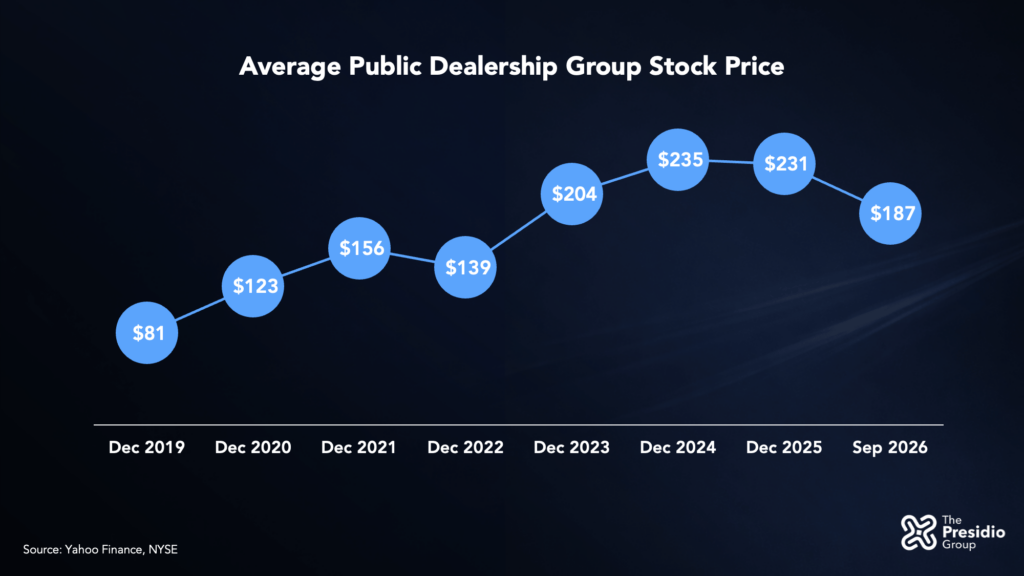
Combined market capitalization for the six publics was $32.6 billion as of Sept. 30, down 11.9% since year-end 2025. Excluding Penske, market cap dropped 26.8% during that period. With its take-private offer at play, Penske’s stock price increased 12.0% during the third quarter, while share prices dropped for Asbury, AutoNation, Group 1 and Sonic and rose slightly for Lithia.
Bottom line: The publics’ earnings declines narrowed in the third quarter, but the pressures behind them persisted. Profitability slid on new vehicles and in F&I, with used vehicles a partial offset. Fixed operations grew only slowly, and expenses took a larger share of gross profit. Executives are counting on technology rollouts to improve expense leverage, but most of that payoff is still ahead.