Publics’ Q2 results diverge even as vehicle margins show signs of sequential stabilization
The six U.S. public dealership groups all faced a similar operating environment in the second quarter of 2026. But their results varied widely as affordability concerns again pressured consumers, fixed-operations growth continued but at a slower pace and new-vehicle volume and gross slid against a year-earlier period lifted by tariff pull-ahead demand. On a positive note, per-vehicle profitability for the peer group appears to finally be stabilizing when viewed sequentially across the last few quarters.
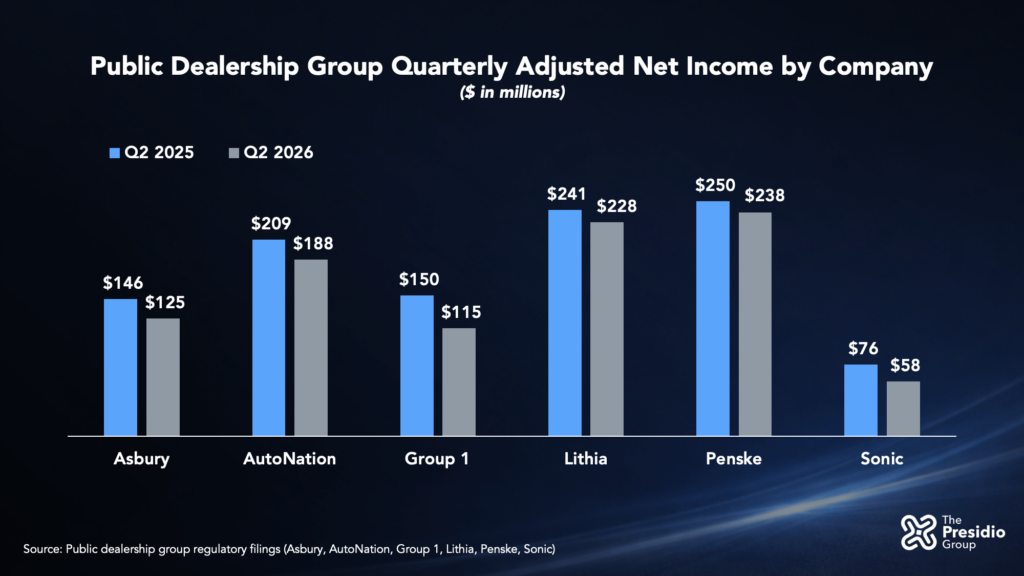
The six publics — Asbury Automotive Group Inc., AutoNation Inc., Group 1 Automotive Inc., Lithia Motors Inc., Penske Automotive Group Inc. and Sonic Automotive Inc. — collectively generated $951 million in adjusted net income in the second quarter, down 11% from $1.07 billion a year earlier. All reported lower adjusted net income, but the level of decline ranged widely. Penske’s adjusted net income fell by 5%, Lithia’s by 6%, AutoNation’s by 10% and Asbury’s by 14%. Group 1 and Sonic posted the steepest drops, both down about 23%.
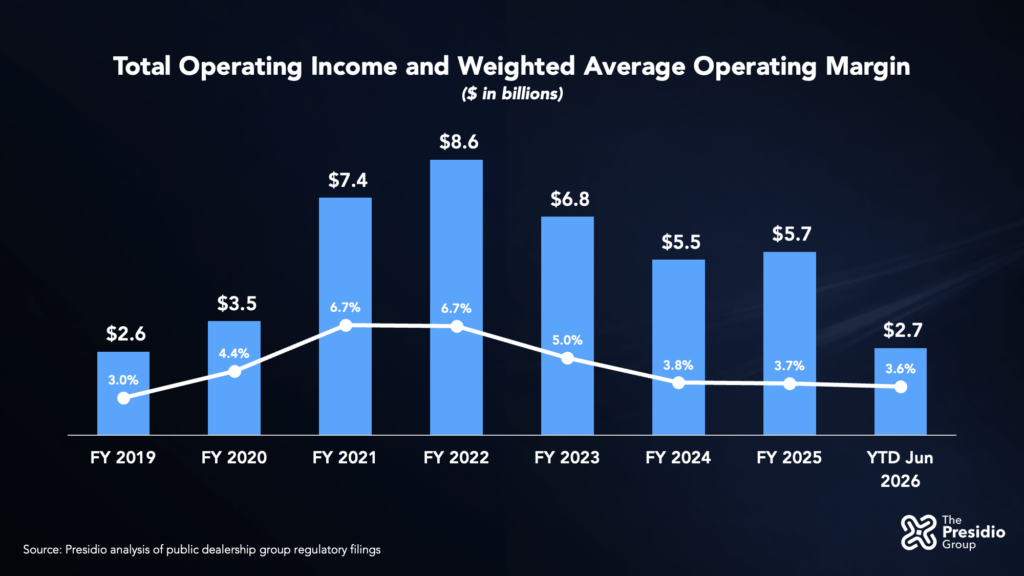
The peer group’s weighted average operating margin stood at 3.6% through June, down from 4.4% for first-half 2025 but just marginally below full-year 2025’s 3.7%. Because the tariff-induced new-vehicle buying surge in March and April last year lifted volume and margins above historical norms, the full-year 2025 margin provides a cleaner comparison for this year’s first half.
As pandemic-era vehicle profits have eased, public dealership group management teams have increasingly focused on vehicle volume-margin balance, expense control, capital allocation strategy and technology pursuits. Even with the decline, the publics continue to deliver operating margins well above the 3.0% level of pre-pandemic 2019.
Vehicle profits fall, but sequential trends show stabilization
New-vehicle profitability appears to be stabilizing on a sequential basis. The publics’ average per-unit gross profit has stayed within a relatively narrow range over the past three quarters. Lithia touted three consecutive quarters of stability for new-vehicle profitability. Penske has posted four straight quarters of relatively stable gross profit per new vehicle retailed.
Despite the sequential improvement, new-vehicle margin pressure continued on a year-over-year basis. Using Presidio’s weighted U.S.-adjusted peer composite, which excludes non-franchised dealership and non-U.S. operations where possible, same-store gross profit per new vehicle fell 12.3% to $3,161 for the peer group. Adjusted same-store new-vehicle unit sales dropped 2.5% collectively. The tough comparison against the year-earlier period in part stemmed from that tariff-driven new-vehicle sales surge early in 2025’s second quarter.
U.S.-adjusted same-store gross profit per used vehicle was essentially flat year-over-year for the peer group at $1,846, down just 0.1%. On a sequential basis, composite used-vehicle profitability rose for a second straight quarter.
The performance echoes stabilization patterns emerging in the broader Presidio-NCM Average Dealership Performance Benchmark dataset. While vehicle margins remain far below the highs of 2021 and 2022, recent sequential stability suggests the sharpest phase of deterioration may be over.
Used vehicles offered one of the clearest examples of divergence in the quarter among the publics.
Lithia’s same-store used-vehicle gross profit per unit jumped 20%, or $339, on a sequential basis. CEO Bryan DeBoer attributed the gain to pricing discipline, artificial intelligence tools and operational execution.
“In used vehicles, our profitability strategy is delivering and a real testament to our ecosystem, AI and people all working closely together,” DeBoer said on Lithia’s earnings call.
Asbury shifted strategy during the quarter as same-store used-vehicle volume dropped nearly 14%, while per-unit gross profit rose. CEO Dan Clara noted a 5% sequential gain in per-vehicle profit and said Asbury in May began prioritizing used volume while maintaining healthy per-vehicle profitability. He said he expected used-vehicle volume gains to show up as Asbury moves into 2026’s fourth quarter.
At Group 1, falling same-store used volume and gross profit per unit combined for an 18% drop in total used-vehicle gross profit dollars in U.S. operations. CEO Daryl Kenningham said the company started the quarter with just 26 days of used-vehicle supply and chose not to aggressively replenish that stock through auction purchases, citing the need to protect profitability ahead of seasonal used-vehicle depreciation.
New and used volume in the quarter also were affected by what Kenningham called a “short-term disruption” from the company’s transition to the Group 1 corporate name across its dealerships, replacing regional brand names.
Fixed operations is a boost, but growth rates are narrowing
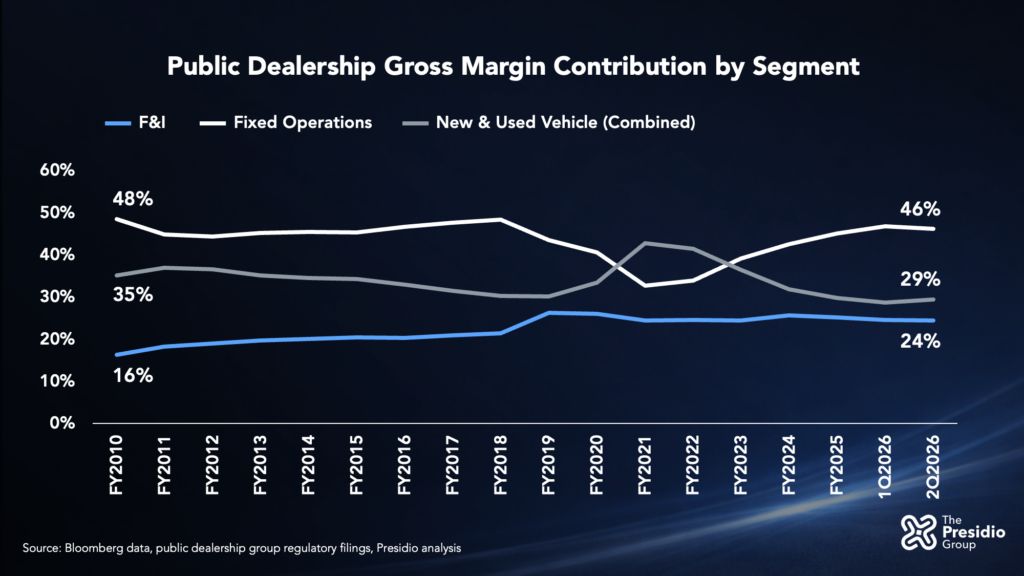
Fixed operations remains a major earnings pillar for the publics, but gross profit growth is slowing. Adjusted same-store growth rates for the peer group have narrowed to 3.0% in the first half of 2026 and to 1.6% for the second quarter alone.
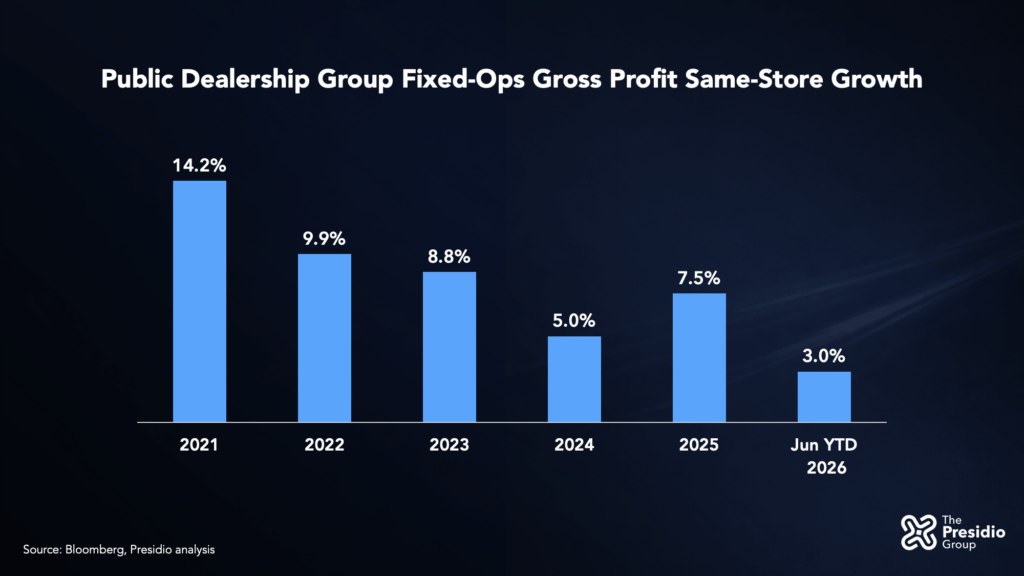
Performance varied across the six companies. According to a Presidio analysis, same-store fixed-operations gross profit for the quarter declined 0.1% at Group 1 and rose 0.1% at AutoNation, 0.3% at Asbury, 2.2% at Sonic, 3.1% at Lithia and 3.4% at Penske.
Company leaders called out a disconnect between the softer growth seen in the second quarter and the long-term positive fundamentals of the fixed-ops business. Beyond the publics, dealers remain broadly optimistic about parts and service, with 80% of respondents to the Presidio Midyear 2026 Dealer Direction Survey identifying it as one of their expected top profit drivers over the next 12 months.
Sonic executives described the quarter as a “wobble” across the industry despite favorable long-term conditions for parts and service like the large and aging car parc. AutoNation leaders made a similar point, characterizing the weaker margin performance as largely mix-driven and temporary rather than a structural slowdown.
Affordability is both a challenge and an opportunity going forward, public group management said. High vehicle prices and older vehicles should continue to drive demand for service and repair work. But franchised dealerships can also do a better job competing on value, they added. Sonic said it is expanding value-pricing programs and service-focused marketing to address customer perceptions about dealership pricing.
“There is tons of opportunity in the car parc that’s out there,” Sonic President Jeff Dyke said. “We are focused on mid-single-digit to upper-single-digit growth. Anything less than that, it’s just not acceptable. There’s just too much opportunity.”
Expense control increasingly separates operators
Lower vehicle margins and slower fixed-operations growth increase the importance of cost discipline. Several of the publics announced plans to tackle costs after the peer group saw operating leverage slip during the first quarter.
That leverage turned around during the second quarter. On a weighted composite basis, adjusted selling, general and administrative expenses accounted for 69.0% of total gross profit in the quarter for the publics, better than their collective mark of 71.6% in the first quarter.
Group 1, Lithia and Asbury delivered some of the clearest progress on that front.
Group 1 went from SG&A leverage of 73.3% in the first quarter for its U.S. business to 66.4% in the second quarter and completed a previously announced effort to cut $50 million in annualized U.S. store-level expenses and to reduce headcount by about 700 employees. Kenningham said the company exceeded those targets.
Lithia went from 71.5% in the first quarter to 68.6% in the second. Asbury achieved SG&A leverage of 66.0% in the second quarter, down from 68.6% in the first quarter. Executives from both companies credited technology advances in part for the improvements. About 70% of Asbury’s dealerships had completed their conversion to the Tekion dealership management system by late July, and productivity gains are already apparent at the stores furthest along in the rollout, company leaders said. Asbury said SG&A leverage could reach the low-60% range once implementation is complete and the tech efficiencies are fully realized.
Lithia leaders noted a nearly 3% reduction in personnel costs and said overall expense progress reflected structural changes, including role consolidation, remote functions, automation, vendor consolidation and early use of Pinewood.AI’s technology platform. Lithia is adopting Pinewood across its store network, with rollout to North American dealerships slated to begin later this year.
Capital deployment highlights strategic differences
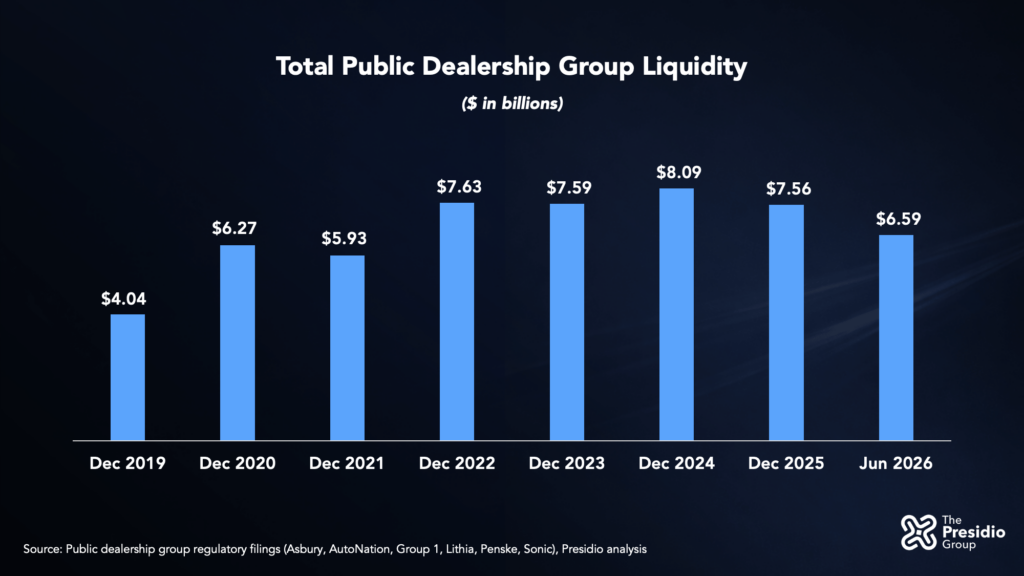
While overall liquidity dipped, the peer group retained substantial financial flexibility, with total liquidity of $6.59 billion as of June 30, 2026. That was down from $7.56 billion at year-end 2025 but still well above the $4.04 billion recorded at year-end 2019.
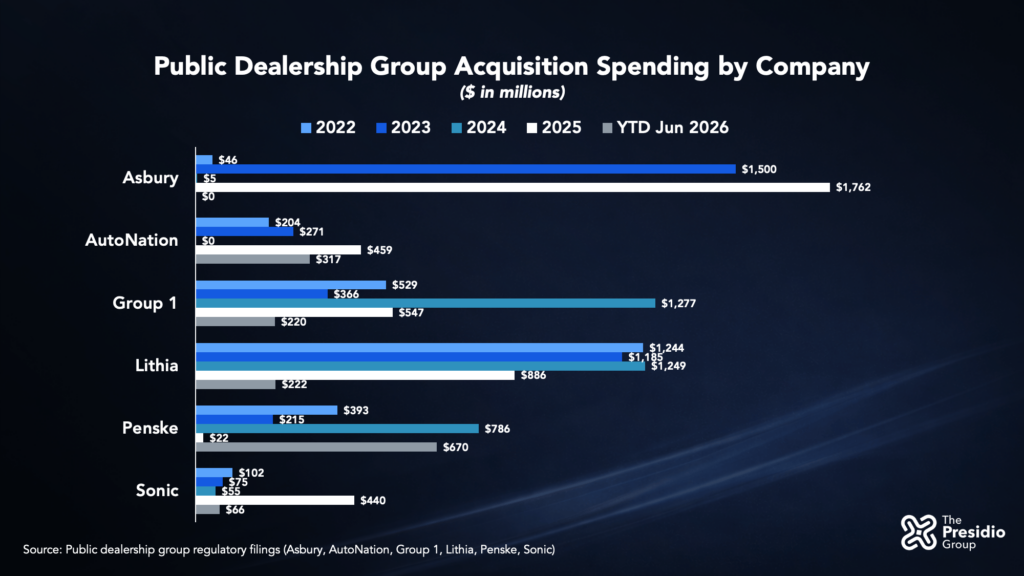
Lithia used that flexibility aggressively. The company repurchased $242 million of its shares during the quarter, acquired five dealerships and divested three, increased its quarterly dividend by 23% and reiterated management’s view that its stock is undervalued.
Group 1 pursued portfolio reshaping, announcing the planned acquisition of 10-store Hennessy Automobile Companies in the Atlanta market. That transaction would add about $1.7 billion in annualized revenue when complete. Group 1 also continued divesting stores that don’t fit its preferred profile of premium brands, high-revenue locations and growing markets. It sold Toyota and Honda dealerships south of Atlanta in June and July. That followed the divestitures of two California Mercedes-Benz stores during the first quarter, including the March sale of Mercedes-Benz of Beverly Hills, a transaction facilitated by The Presidio Group.
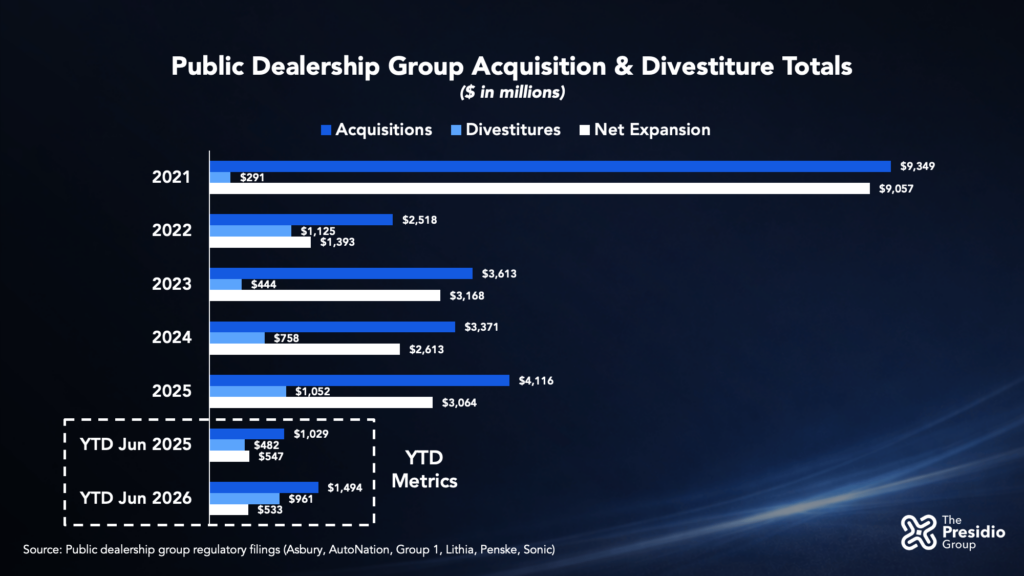
Asbury leaned heavily into share repurchases, buying back $131 million of stock during the quarter and $278 million during the first half. Management said buybacks currently offered a more attractive return than many acquisitions the company had reviewed.The publics collectively spent about $1.49 billion on acquisitions during the first half of 2026 and generated $961 million in divestiture proceeds.
Valuations reflect a changing market backdrop
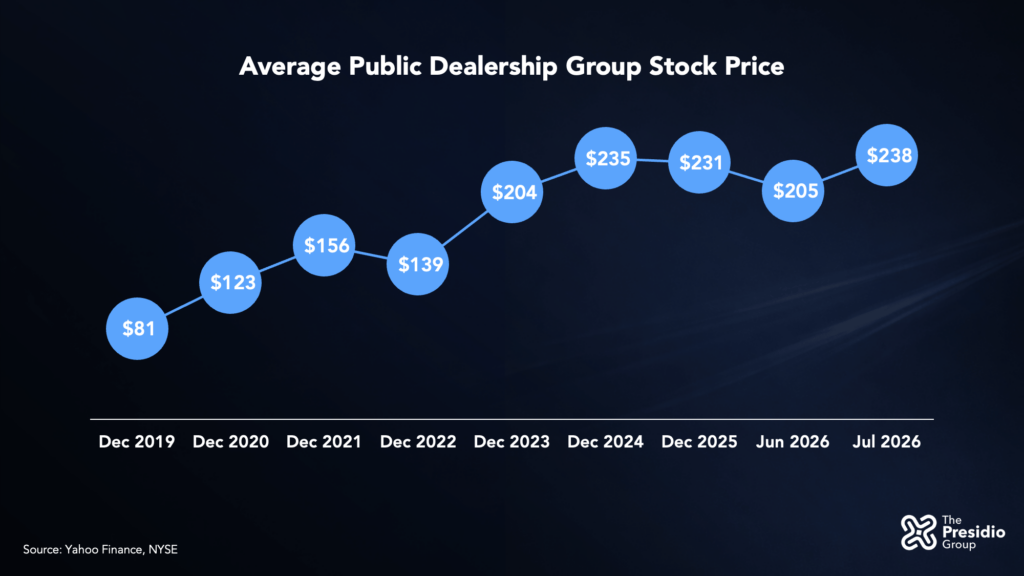
Presidio typically calculates enterprise value/adjusted EBITDA multiples at quarter’s end, and those figures are included in the first chart below. But July saw significant changes in share prices as the market absorbed the earnings announcements for the peer group and notably after Penske Corp. and Mitsui proposed acquiring the remaining publicly held shares of Penske Automotive Group. Presidio subsequently reexamined valuation multiples as of July 31, excluding Penske from peer group calculations while the potential take-private deal is pending.
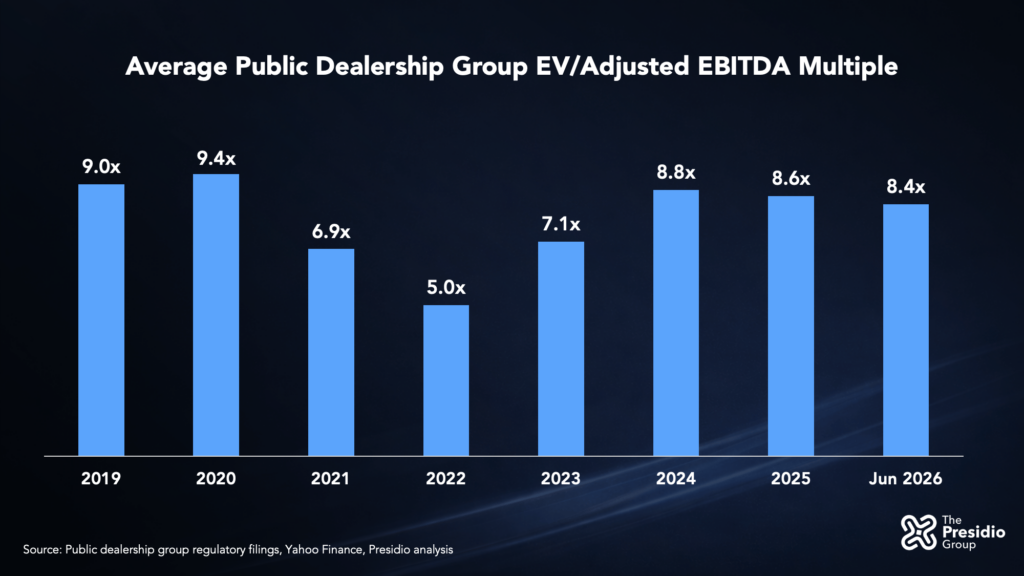
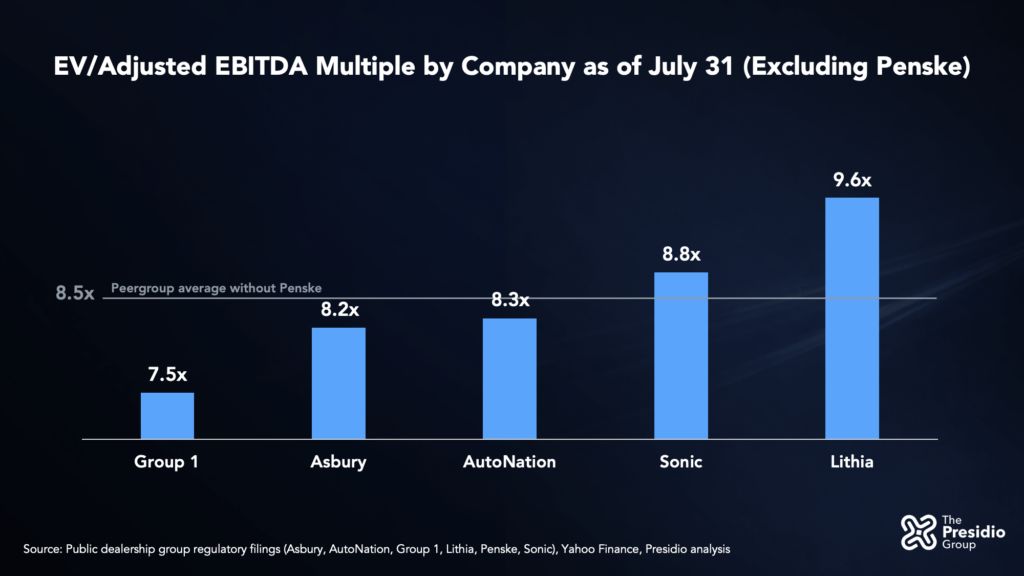
Without Penske, the average multiple rose from 7.7x as of June 30 to 8.5x as of July 31, demonstrating an overall positive market reaction to second-quarter results. Leaving Penske out of the average likely provides a cleaner view of underlying sector valuations. It also shows little change for the peer group from the six-company average EV/adjusted EBITDA measurement of 8.6x at the end of 2025.
Bottom line: Sequential vehicle-profitability trends suggest margins may be stabilizing after a multi-year decline from peak pandemic levels, a pattern that Presidio is also seeing in the broader franchised dealership population. But results for the second quarter increasingly differed across the six public companies. As operating conditions stabilize, more attention will likely be placed on how each company navigates this cycle. In the second quarter, those differences were already showing up in earnings, strategy and valuation.